


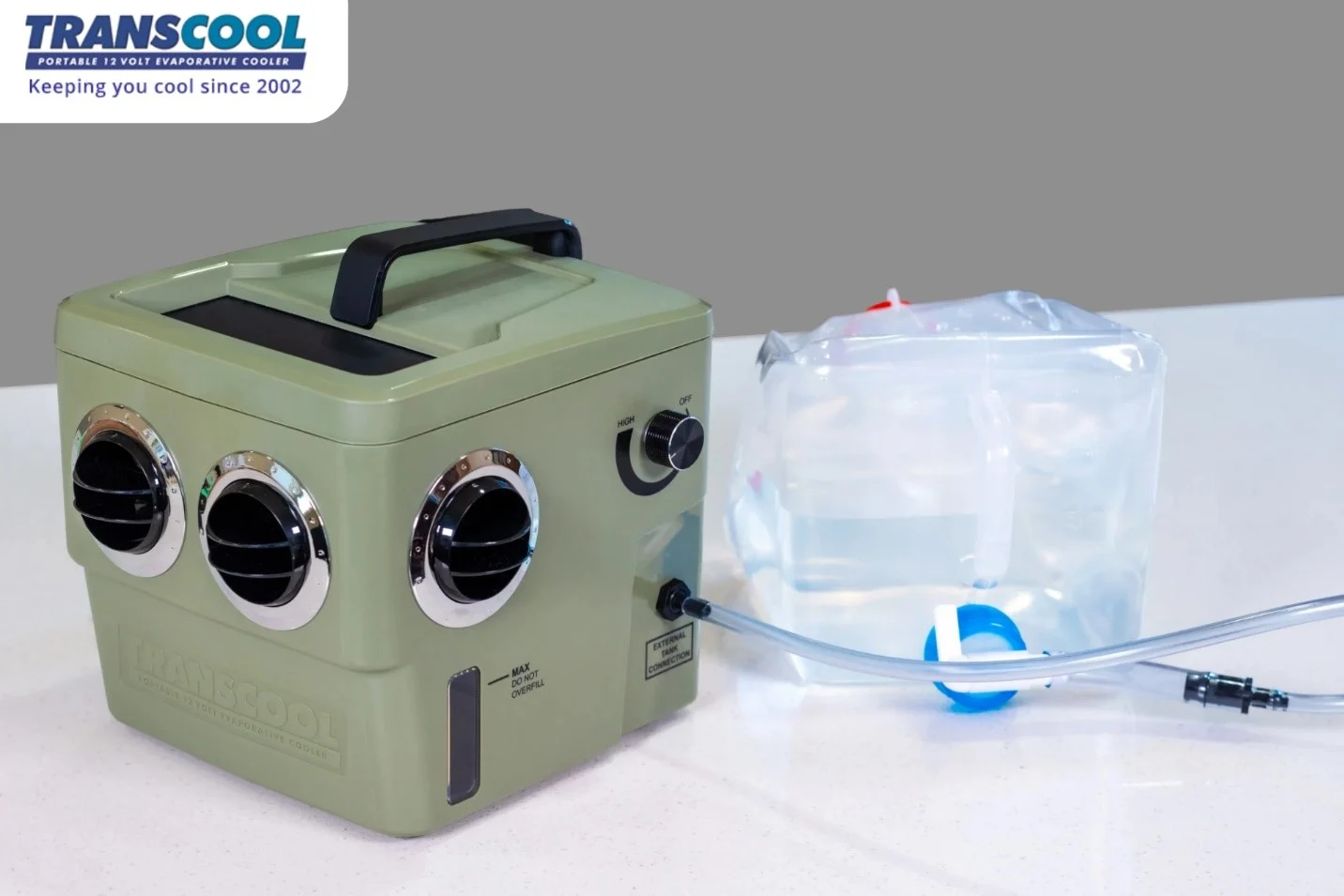
Portable cooling is no longer confined to wall sockets and fixed installations. The 12-volt portable cooler has become a genuinely useful tool for people who work on the road and live off-grid. It is also for the people who want instant and localized comfort.
We at Transcool design and recommend units that are compact and flexible. Many models available today will run on 12 or 24 Volt DC or 24V mains power. They give you true multi-environment versatility.
This article will tell you: What these coolers do. Where they make sense. How to choose one. How to get the most from it.
What a 12-volt portable air cooler actually is
A 12-volt portable air cooler is a lightweight and fan-based cooling device that generally uses evaporative cooling or a small compressor to reduce perceived temperature in a limited area.
They are not like whole-room air conditioners. These units are designed for spot cooling and are built to draw power from low-voltage DC sources: Vehicle batteries. Solar systems. Standard 240V mains when an inverter or dual-input model is used.
The defining advantage is mobility combined with low power draw compared to full-sized ACs.
Why dual-power capability matters: DC and mains flexibility
One big reason buyers prefer units that run 12 or 24 Volt DC or 240V mains power is flexibility. DC is the natural source when you are in a car or truck. 240V mains is available at home or in a job site cabin.
A cooler that accepts both inputs removes the need for additional inverters or complex wiring. It reduces conversion losses and unnecessary battery drain. Multi-input units are a sensible investment for people who split time between mobile work and stationary locations.
Cooling performance and what to expect
Expect spot-cooling rather than whole-room comfort. Evaporative models work best in dry climates: They lower perceived temperature by adding moisture and moving air. Compressor-based portable units (less common at 12V) behave more like mini air conditioners and can provide meaningful temperature drops even in humid conditions! But you know what? They draw more power and are generally heavier.
Consider: Airflow (measured in CFM). Cooling method (evaporative vs compressor). Water tank size for evaporative units. Any stated coverage area. All these factors are important to consider when you compare models.
Also consider the power draw in amperes at 12V! This tells you how long a battery can power the unit and whether your vehicle’s alternator or solar setup can sustain it.
Energy use, battery considerations, and run-time
One of the main benefits of the 12-volt portable air cooler is low energy consumption. Typical evaporative coolers can operate at relatively low amperage. This makes them compatible with modest battery banks and small solar systems.
Still, you should calculate run-time carefully: Divide your battery amp-hours by the cooler’s amp draw and factor in safe depth-of-discharge limits (50% is common for lead-acid & lithium allows deeper cycles-up to 90% DOD)
Make sure you have adequate stored energy or a gentle alternator charging profile when driving if you plan to run the cooler while the vehicle is off.
You’ll often see lower amperage for the same power if a model supports 24 V DC. This can be more efficient for larger vans or trucks with 24 V systems.
Noise, size, and portability trade-offs
Portable coolers vary in sound level. Fans and compressors are audible. Choose a model with a lower DB rating and multiple speed settings if you use the unit in a small cabin or sleeping area.
Size matters too: Larger units provide more airflow and longer water capacity. But weigh more and take up more space. Prioritize compact and lightweight models with handles or mounting options if mobility is important.
Installation and practical tips
Most 12-volt portable air cooler units require minimal installation! Plug into a compatible 12V socket. Clamp to a battery. Use the included AC adapter when mains is available.
Consider a secure mounting bracket and a clean fuse-protected wiring connection to the battery or fuse box for semi-permanent installs in vehicles.
Always follow the manufacturer’s instructions for DC wiring and avoid running the unit on shallow-discharge batteries for extended periods.
Maintain water tanks and use clean water to avoid mineral buildup for evaporative coolers. Check refrigerant and service intervals just like a small appliance for compressor models.
Click here to check out more related blogs
Safety and maintenance
Use caution when connecting to batteries: Correct polarity. Fusing close to the battery. Proper cable gauge. This prevents voltage drop and heat. Keep vents clear. Clean filters regularly. Remove standing water and run fan to dry the filter between uses to avoid mildew.
Buying tips and feature checklist
Prioritize units that have: Clear power specifications. Dual-input capability. Reliable brand support. Easy-to-service designs. Consider the water tank size for evaporative units: Whether a unit has a built-in inverter for main use, and the availability of spare parts.
Warranty and local service options matter when you intend to use the cooler in remote or heavy-use scenarios.
Final thoughts: Who benefits most from a 12V portable cooler?
Are you in need of focused and energy-saving cooling vehicles and off-grid environments? A 12-volt portable air cooler that can operate on 12 or 24 Volt DC or 240V mains power provides the flexibility no other gadget can match. It is a budget-friendly and mobile option for people who want comfort without installing a fixed HVAC system or depending on high-power solutions.
We at Transcool recommend assessing these things before choosing a model: Power sources. Usage patterns. Climate. Choose a cooler that balances airflow and portability for your particular needs.
Do you want help choosing the best model for your vehicle? Transcool’s specialists can recommend the right Unit.
All customized to your power system and comfort goals.