


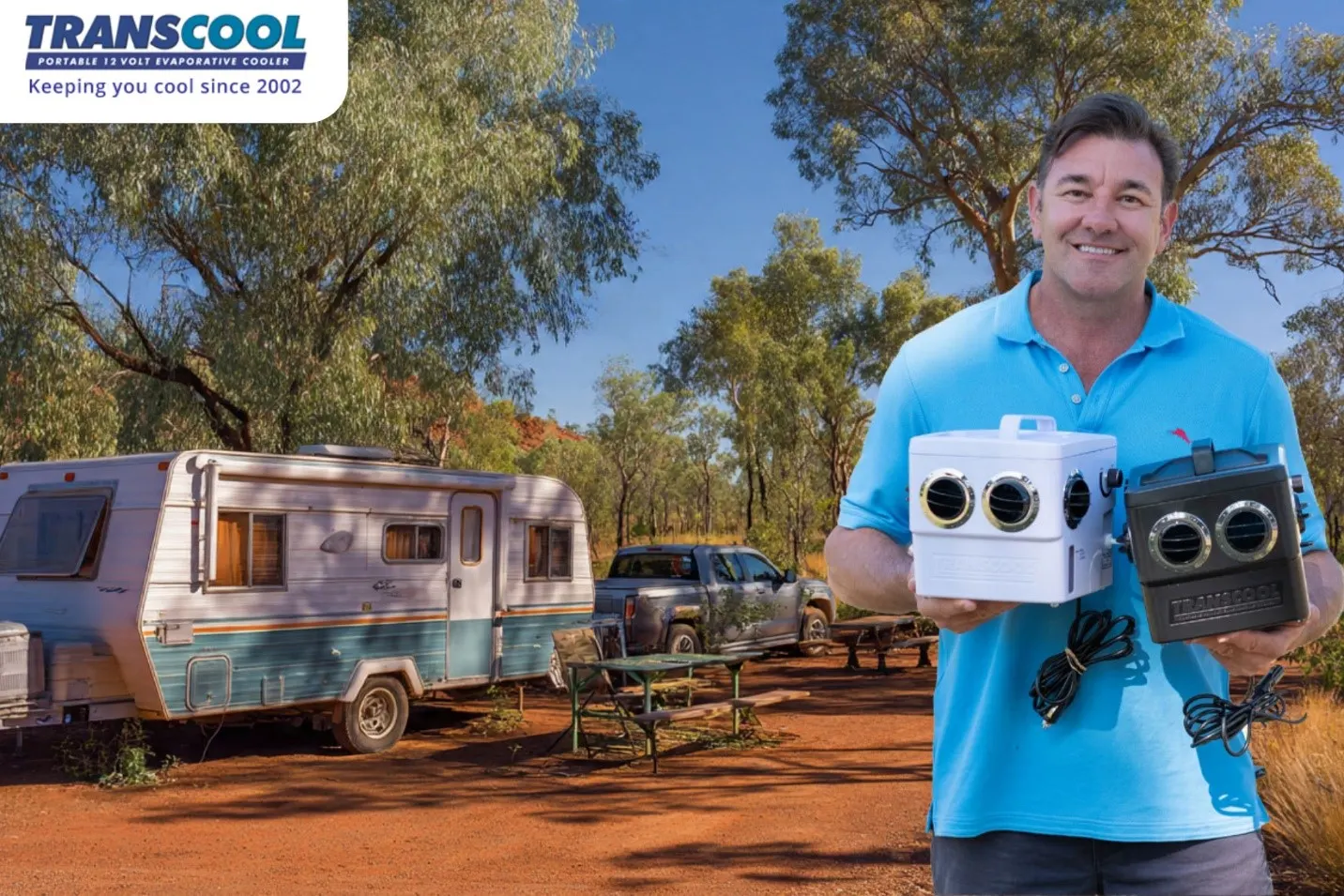
Someone wants the best 12-volt air cooler for camping! What do they want? They are in need of a cooler that provides portability and actual power requirements. Campers and van-lifers need a solution that possesses these properties: Cools a small place easily without consuming a lot of battery. Capable of handling outdoor dust and heat. Swaps easily between vehicle and campsite power.
We at Transcool recommend models that combine efficient cooling with flexible inputs so you get reliable comfort whether you’re on the road or pitched at a powered site. A special advantage is multi-input capability: Many top units clearly state that they run on 12 or 24 Volt DC or 240V mains power. This eliminates difficulty and increases reliability.
Why multi-input power matters for camping
Your available power sources change when you camp: Sometimes you’re tethered to a car battery. Sometimes, you have access to campground mains. Choosing a cooler that runs on 12 or 24 Volt DC or 240V mains saves you from buying inverters or multiple adapters and minimizes conversion losses that shorten battery life.
This flexibility is generally useful for people who use a campervan or split time between mobile and stationary setups. A unit that supports both DC and AC inputs makes transitions smooth and maximizes the cooler’s utility across different trips.
Understanding cooling methods and how they perform outdoors
Every portable cooler doesn’t follow the same mechanism. Evaporative coolers cool by adding moisture and moving air: They are lightweight and energy efficient. But you know what? Their effectiveness drops in high humidity.
Compressor-based portable coolers act more like mini air conditioners and can reduce actual air temperatures even in humid environments: They tend to be heavier and draw more power.
The best 12-volt air cooler for camping depends on where you camp most: Choose an evaporative model for dry and hot climates. Do you frequently camp in humid or coastal regions? Choose an evaporative model for dry and hot climates.
Look for clear specifications: Airflow (CFM). Coverage area and realistic temperature drop estimates rather than marketing claims.
Power draw, battery planning and run-time
No one wants to drain their battery! But how to successfully achieve this? It is possible if you know how much power your cooler uses at 12V. A normal evaporative cooler that pulls around 3-5 amps will operate much longer on a normal leisure battery than a compressor-style cooler that requires 20-30 amps.
Some people want to use the cooler when the vehicle is off! Calculate operation time by dividing your battery amp-hours by the cooler’s amp draw and allow a safety margin to stay away from excessive depth of discharge.
Models that provide both 12 and 24V inputs can be more successful on 24V systems because they consume less current for the same output: The best benefit for larger vans and trucks.
Noise, size, and the portability trade-offs
Comfort at night is a lot more than temperature. The fan and compressor create a noise that can be irritating, especially if you’re sleeping in a small tent or van. The best 12-volt air cooler for camping will provide different fan speeds so you can cool quickly and then settle to a quiet mode for overnight use.
Size also plays a part: Larger units generally provide more airflow and longer water capacity (for evaporative types) but weigh more and require more storage space. Priorities compact and sound designs with secure handles and stable feet that work on uneven ground for true mobility.
Realistic expectations: spot cooling versus whole-room cooling
Portable 12-V coolers are made for spot cooling: A tent vestibule. A sleeping area. A small camper alcove. Not for conditioning an entire RV or cabin.
Expect improved comfort in a defined zone rather than a dramatic temperature drop across a large space. Match the mentioned coverage area to your setup and understand how airflow will be directed inside the tent or van when choosing a unit.
Strategic placement (near sleeping areas or workspaces) considerably improves perceived comfort.
Click here to see more related blogs
Installation, safety, and maintenance
Most units are ready-to-use: A cigarette lighter adapter. A clamp to the battery. A supplied mains cable. Use a fused connection and the proper cable gauge as suggested by the manufacturer to put a stop to voltage drop and overheating for semi-permanent installs in vans.
Regular maintenance keeps performance: Clean or replace evaporative pads. Empty and dry water tanks between uses. Keep vents free of dust and debris. Have you chosen the model that operates on 12 or 24 Volt DC or 240V mains power? Check that the manufacturer includes proper protection circuitry: Reverse polarity protection. Fusing. Surge protection. This helps to protect both the cooler and your vehicle’s electrical system.
Climate and environment: match the cooler to where you camp
Your camping environment should define the cooling technology you choose.
Arid regions: A simple evaporative cooler can improve comfort without using a lot of power.
Humid or tropical environments: A compressor-based cooler that will operate on 12 or 24 Volt DC or 240V mains power is a better fit, despite the higher power demand
Keep seasonal patterns in mind: Whether you frequently camp in shade or open sites. Also, how often you’ll use mains hook-ups versus battery power.
Value, warranty, and spare parts
The cheapest unit saves money initially. But you know what? It costs more over time in repairs and replacement parts. The best 120-volt air cooler for camping balances: Initial price with build quality. Warranty coverage and easy access to consumables such as pads and fuses.
Manufacturers who give clear wiring support and spare parts eliminate the risk of interruption when you’re on the road.
Final thoughts: choose the right cooler for your needs
The decision of choosing the best camper cooler completely depends on trade-offs. It is advised to choose a model that operates on 12 or 24 Volt DC or 240V mains power for excellent performance if you move between vehicles and campsites.
It is important to check the cooling method according to your climate. Size the battery and run-time sensibly. Go with the models that produce low noise and are very easy to maintain.
Transcool suggests evaluating your general trip profile and storage limitations before you choose one. The right cooler will make life outdoors easy without striking the balance between mobility and battery health! That’s the actual sense of portable cooling done well.